From the Hmm, I Did Not Know That, and The No-one Who Reads My FB Feed Cares So This Goes To The Blog files comes this fascinating connection:
In Series 1 Epsisode 8, "The Missing Piece" of Asimov's Foundation on Apple+, "Brother Day embarks on a journey that no other Cleon has ever attempted." This is a religious ceremony that involves a long arduous walk in the sun without food or water that is deadly for many, called The Great Spiral. Br Day expects to reach a sacred cave, referred to as a womb by a priestess (note the rebirth motif) where salt in the water has some mind-altering property that may grant him a vision of the three goddesses (mother, maiden and ... cleaning lady?) and some enlightening message.
And hopefully some aloe vera for that sunburn.
~~~~~~~
It just so happens that The Eleusian Mysteries of ancient Greece bear a striking resemblance, at least part, to this fictional ritual journey. The Mysteries involved a once in a lifetime experience for the elite of the time and requiring them (people like Marcus Aurelius!) to oversome some harsh trials/tests/etc? and reach a certain underground temple or cave, ritualistically descend into hades and return with the goddesses Persephone and Demeter (daughter and mother).
References to re-birth from a seed (it obviously began as an an agricultural festival), visions, a revelation of spiritual and mental enlightenment, and eventually, as the mysteries evolved, eternal life and maybe even becoming a god. Magic mushrooms or some other psychedelic may very well have been involved, but we don't know as the rites were (the clue is in the name) a Mystery.
Anyone seen Marcus?
E@L couldn't find a correpsondence to this TV show's Great Spiral subplot in the books by polymath Isaac Asimov. Well, research, as in he did a search for "cave" and "goddess" in the seven Foundation ebooks he has, with no result. Maybe the scriptwriters' put it in? Seems unlikely. It must be there. Anyone here read them all?
~~~~~~~~
Anyway, it was an interesting (to E@L) parallel, even though he has probably misread the details in the Wikipedia entry completely as he was drinking a double negronic (negrotonic? Anyway, negroni topped up with tonic) as he drafted this.
~~~~~~~~
No doubt a dunk into reddit or somesuch chat area, even Google, would provide E@L with a wealth of discussion on this obvious, to many, association and several PhD theses have already been submitted on it and Stephen Fry probably explained it on Qi (even though he doesn't do it anymore) or in his latest book, and it is only because E@L lives in isolation from the cultured world (the bars of Bangkok and breweries in Singapore?) that he can claim to claim it as his own discovery.
To be totally honest, the correspondence hit E@L while he was doing his daily constitutional around said culturally isolated home village, sipping his barista-brewed flat white, and listening to a recent Sam Harris podcast on the use of psychedelics in religious ceremonies in the ancient western world, and the blindingly obvious pagan origin of many Christian rituals, natch. The guest describes the Mysteries in as much detail as, even more than, any brain could hold onto, least of all the exploding one of
In case no-one has noticed, I should explain that I am having trouble making a start on any of those writing projects I told myself I’d be doing to soak up the damp hours and soggy days of retirement (enforced, or otherwise)
When someone asked Anthony Burgess if he had ever had writer's block, he shot back, in typical snarky Burgess fashion, “Of course not. I am a writer. I write. Have you ever heard of a cobbler getting cobbler’s block?”
~~~~~~~
Ha.
My paternal great-great-grandfather, Charles Radnell was one of the two cobblers in a small town of Tarnagulla, initially called Sandy Creek, in "The Golden Triangle" of central Victoria in the mid/late 19th century, from the time of rapid development in that area during the great gold rush.
His father (also named Charles) back in Nottingham was a leather-worker and harness-maker, and GGGF Charles presumably picked up the suitable shoe-making skills from him. It seems that after said GGGF Charles passed away in 1890, the tools of the trade; its awls, chisels, punches, edgers and various knives and cutters, and shoe rests or lasts, presumably went to his son (my GGF) William John, the second child with that name. His namesake, the firstborn, died at 10 months while GGGF Charles and GGGM Sarah were living in a tent town, in the goldfields of Llanelly at the height of the Victoran gold rush.
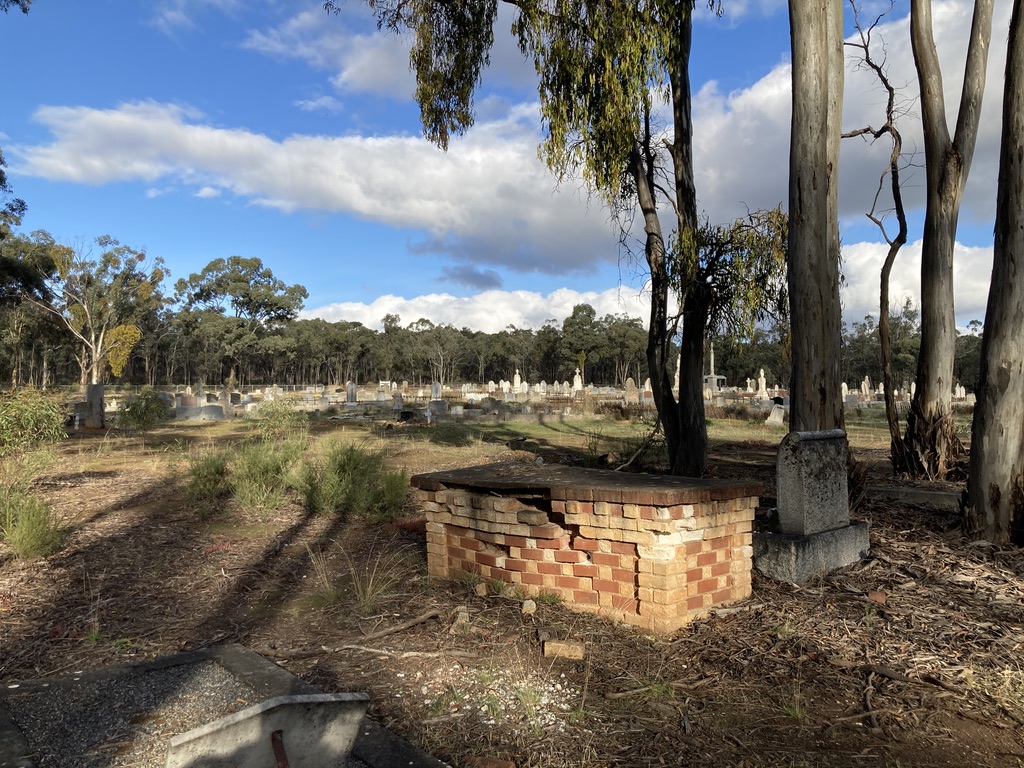
"Diggers" were coming in from all over, including Hong Kong and the provence of Canton. There are several Chinese memorials doing their best to survive the elements in the town's cemetery. Lots of stories which I won't go into here about the struggles of the Chinese in Australia during the gold rush.
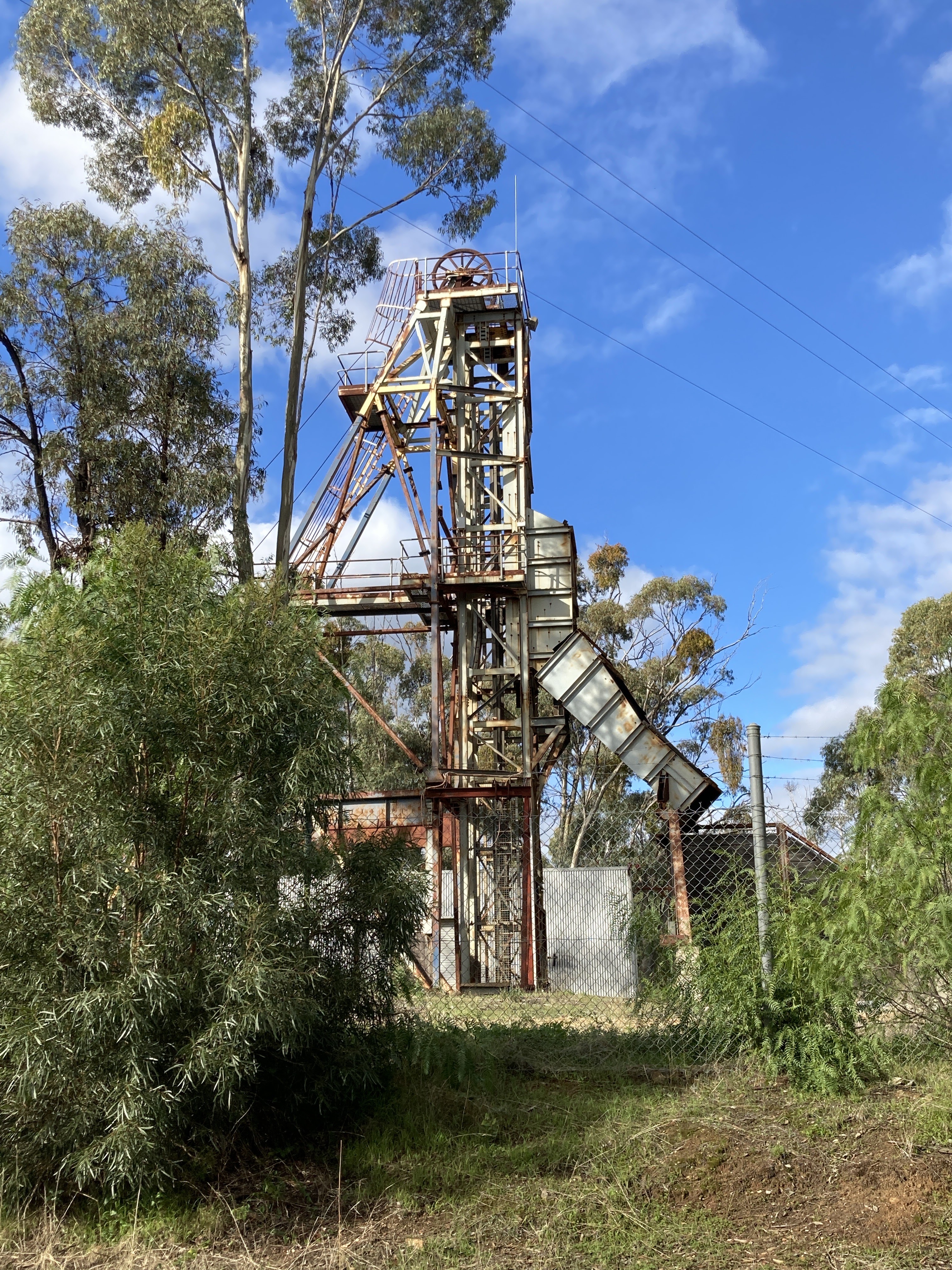
For the lucky few, a good living could be made in the many gold strikes in the region, such as the Poverty Reef mine, right in the heart of Tarnagulla, which was still in full stride when GGGF Charles moved into town in 1853. Several of his sons, GGF William John maybe, and his brothers, later worked there. Two of the six brothers, Charles(!) and George, were killed in action in the Great War.
I am guessing this heritage of cobblerdom because I don't know what GGF William John's actual trade was, but when his daughter, my paternal GM, Ethel [daughter of Annie née Titus - aunt of the great Richmond footballer in the then VFL, now AFL, Jack Titus] married my GF, John George Ramm, apparently known as George. [Geo. the Neat Executor of the card, below], the evidence would strongly suggest that he learnt the trade as well. ["Bot. of" - meaning: ???]
There was only one cobbler in town by 1920. That would have GF Geo, who lived there until he passed in 1950.
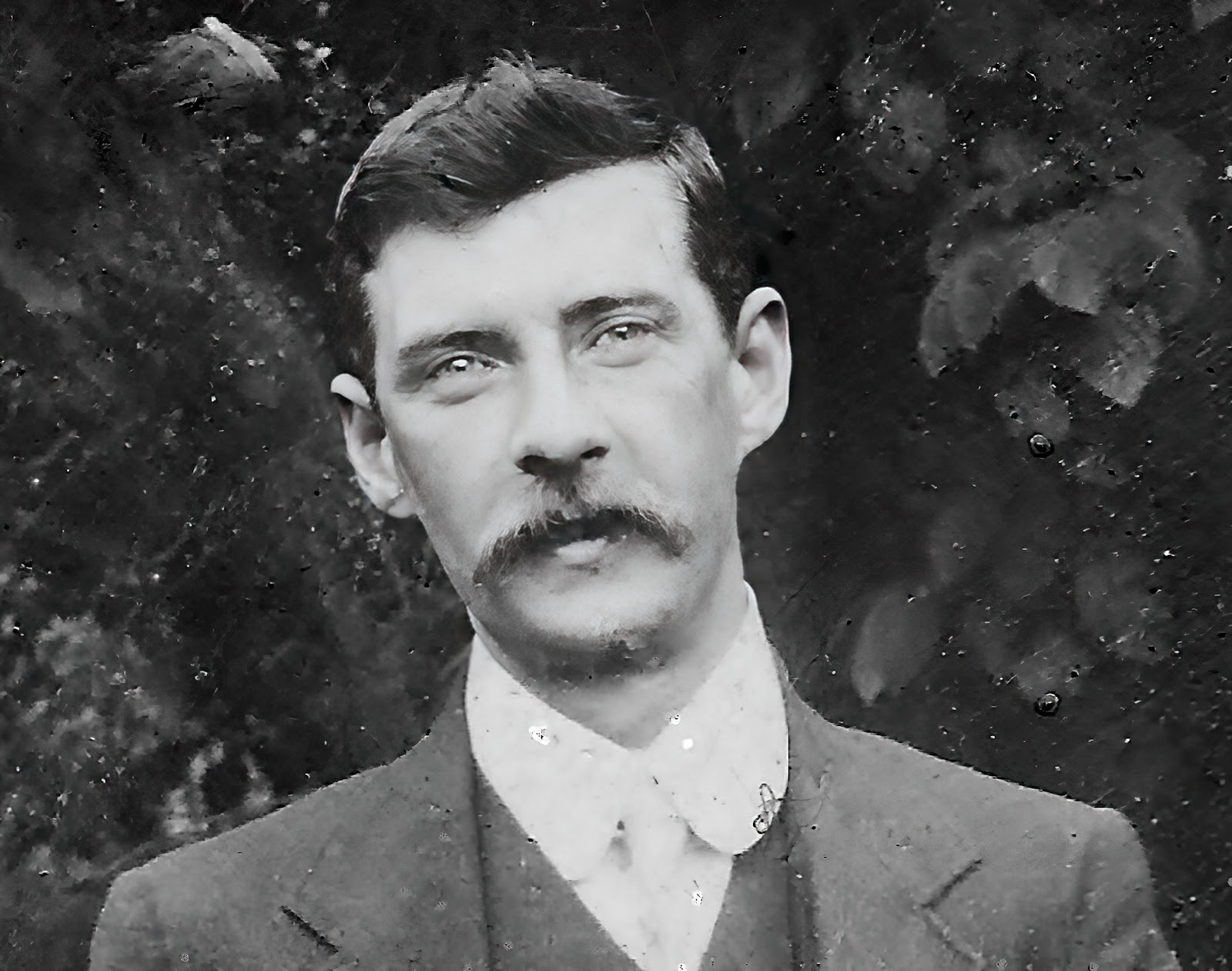
A young GF John George (Geo.) Facial enhancement by Topaz AI.
Of course, back in the heady rushed days of sudden golden wealth and desperate arduous slog in mud and non-glittering rock, those gold miners needed solid work boots. Their wives needed dress shoes too, maybe with bows on them, for social events at the town's Garibaldi Lodge or, in later days with Geo as bootmaker, at the Masonic hall in nearby Dunolly...
So for a fair part of a century, the Radnells and a Ramm ran the town's cobbler business, unblocked.~~~~~~~~~~
Aside: The Poverty Reef mine in Tarnagulla was named after Poverty Bay, the New Zealand home of the two prospectors who made the first strike there. And then they made their fortune. Isn't that ironic! Doncha think?
The mine was intermittently operational until quite recently, though it peaked production with 13½ ton(!) of gold in the inital years of 1852-53.
As the seam became exhausted, different methods of gold extraction were tried there, and the first cyanide factory in Australia was built just behind it.
Some locals
~~~~~~~~~
This is the house where my paternal family lived. I guess it is where my father was born. When we were young kids, our widowed mother required respite, so each summer we stayed with my uncle and aunt who still lived there, for two weeks or so. But we weren't to go into the closed front room, the one behind what once might have been a shop window (presuming here), under the recently refurbished awning.
Too much important stuff in there for clumsy children. General uncle and aunt storage, my father's stamp collection for sure, etc... And some of my great-great, and great, and grandfather's work implements.
When we were allowed in, once only I think in the many years we holidayed there, I recall trying to figure what this strange multi-footed steel montrosity was exactly. I doubt that we could have damaged it, however clumsy we were.
(Not GGGF's or GF's but same same.)
A cobbler's last. A block of steel that allowed consistant work from a range of angles. Shoes for men, women, and children, made to order. Neatly executed repairs. And cheap!
If I had one now, I would rub it as a talisman of progress, and getting a move on from this blogger's block would be
Interesting. Not ironic, merely coincidental. Merely an example of Littlewood's Law, roughly: "A person can expect what appears to be a "miracle", that is, something with odds of around a million to one, to happen to them about once a month."
What is this rare, nay, semi-miraculous proto-religico/mathematico occurrence, you ask. What has brought once prolific and popular blogger E@L back from the brink, yea, from staring into the blind, echoless abyss of not writing much these days?
E@L has come across the word "Savoyard" twice in as many weeks. It was a new one on him, as are most references to cultural things.
Wow! hey?
~~~~~~
In his semi-autobiographical 1964 novel My Brother Jack, the Australian writer George Johnston* has his proto-self, proto-agonist David Meredith, working at an elite printing firm in Melbourne (as did Johnston). The printers were more than mere craftsmen: they were also artists, designing and etching the posters and advertisements themselves, as commissioned.
But they had other, dare I say cultural** interests:
"... because every one of them was a fanatical Savoyard, and at any hour of the working day would be as likely as not to burst into a chorus from HMS Pinafore or Yeomen of the Guard or Pirates of Penzance, then everyone would join and the whole studio would rock to Gilbert and Sullivan airs..."
(approx location 1210 of 6276 on Kindle)
Savoyard: 2: a person enthusiastic about or connected with Gilbert and Sullivan operas: so called from the Savoy Theater in London, where the operas were first presented. (Dictionary.com)
~~~~~~~
In her most-amusing 2004 novel (and aren't they all?) The Finishing School", Muriel Spark arranges it so that the students of College Sunrise in Ouchy, a lakeside town just out of Lausanne, leave their laptops and knapsacks behind and head off on a ferry down Lake Geneva to the Chateau of Chillon.
It was while he was in Ouchy itself, in 1816, that Lord Byron, who was with Shelley on holidays [i.e. fucking whomever they could catch], wrote an allegedly well-know poem [not to E@L] about a certain prisoner who was kept in a dungeon there (Chillon) for six years. François Bonivard, the Prisoner of Chillon, was imprisoned (with his two brothers, according to Byron) in an underground cell because of his radical political views, espousing the independence of the Genevese area from The Duchy of Savoy. The Duchy at the time of Bonivard's incarceration [1530's or so] included a chunk of what is now eastern Switzerland: all the shores of Lake Geneva, from Geneva around to Lausanne, and then to Montreux. Chambery, in what is now France (Savoie or Haute-Savoie, can't be fucked looking it up - E@L is 6hrs into this post already) was then the capital, but Savoy included the Piedmontese area around Turin, and down to the Mediterranean at Nice. Lots of geo-politics going on as you would imagine. But of that, more later.
OK, so the students are told to ponder on Byron's poem while they were at the Chillon chateau.
What next befell me then and there
I know not well—I never knew—
First came the loss of light, and air,
And then of darkness too:
I had no thought, no feeling—none—
Among the stones I stood a stone,
And was, scarce conscious what I wist,
As shrubless crags within the mist;
For all was blank, and bleak, and grey;
It was not night—it was not day;
It was not even the dungeon-light,
So hateful to my heavy sight,
But vacancy absorbing space,
And fixedness—without a place;
There were no stars, no earth, no time,
No check, no change, no good, no crime
But silence, and a stirless breath
Which neither was of life nor death;
A sea of stagnant idleness,
Blind, boundless, mute, and motionless!...
Listen: Chris, one of the more precocious students is writing a novel about Mary Queen of Scots, the murder of her husband Lord Darnley, and the assassination of her recently repositioned personal seckertary and alleged boy-toy, David Rizzio, formerly of, wait for it, the Duchy of Savoy - he was born near Turin. When Rizzio was stabbed 56 times in 1566, Lord Darnley was then estranged from Mary, an 'orrible 'usband [marry in haste, repent in hell not long after] who had been buggering none other than Rizzio for many a moon previously. He feared most murderously that his (Rizzio's) ascendancy in her (Mary's) eyes threatened him (Darnley) both politically and romantically. [E@L is toying most flagrantly with history here, having only half-remembered pieces of the story from a recent Melvyn Bragg podcast, and less-than-half-read Googled snippets to go on]. After Rizzio's body is disposed of, Darnley, King of Scotland, gets, naturally enough for those days, back with his once-hated and conspired-against Queen. But he is murdered himself next year by the Earl of Bothwell, who marries MQoS after raping her [rape in haste, marry and murder at leisure], and the rest is history. But Chris's "excitingly written" twist on the story is that Darnley was in fact murdered by assassins sent from Savoy by Rizzio's family of diplomats (aka spies). Whoof.
Anyway, [are you still with me?] Chris, the aforesaid precocious student and inchoate novelist at the Swiss finishing school of the novel's (Spark's) title, was on the ferry, thinking of Bonivard and Rizzio, who were, #foreheadslap, roughly contemporaries:
"They might have met. They lived in different worlds yet it was not impossible that the lordly Savoyard should encounter the young Piedmontese diplomat who won his way into the courts of Europe." (Pg 23.)
Savoyard: 1: a native or inhabitant of Savoy. (Dictionary.com)
~~~~~~
But of course, checking the maps of the region, although it was difficult to pin down exactly the gerrymandering going on over the centuries with Google and not a proper historical atlas, E@L has discovered a possible misfiring in Spark's research/reasoning.
Turin was, as mentioned, in the Duchy of Savoy during the 16th century, and became the capital in 1563. It had been part of Savoy for six centuries and would remain so for two or more, um, more. Rizzio would have considered himself as much a Savoyard as Bonivard, rather than just a Piedmontese. [Perhaps, but for the sake of spectacularly iconoclastic blogging, let's say, Yes]. And, more controversially, Bonivard, imprisoned as a Genovese secessionist, might justly bristle at being called a Savoyard, when he most devoutly wished to be anything but one.
The history of the area is complex, to say the least at this time of night. Lausanne and Geneva did not remain in Savoy much longer. Those of the House Savoy became, firstly, the Kings of Sardinia (which included a state of Savoy that commenced below Lake Geneva, and had Piemonte as a separate state), and then the Kings of Italy, reigning from Turin, after the unification (also once called the "Piedmontisation") of Italy.
~~~~~~~
As another aside, while Muriel was writing this, her last novel, in a little village in Tuscany (about 60km from where E@L experienced the infamous "angina incident" of 2012), a political group in Savoie and Haute Savoie, the areas of France around Chambery (former capital of the Duchy, remember?), The Savoyan League, were calling for the unification and independence of the French speaking regions of l'ancien duché de Savoie. They gained 5.39% of the vote in the area in 1998, but failed to turn up at the 2004 elections.
~~~~~~~
Fascinating. Maybe not in your opinion, certainly in the opinion of
E@L
[Footnotes]
* E@L is reading My Brother Jack (he should have done so many years ago) because George Johnston is mentioned, photographed even, with his wife Charmian Clift, in So Long, Marianne: A Love Story, the bio-story of the muse of Leonard Cohen's classic song, which E@L found in Kinokuniya and still hasn't started reading because: see above.
This had prompted E@L to pull out his almost as unread copy of Garry Kinnane's wonderfully titled 1986 biography of George Johnston, George Johnston: A Biography. Inside of which, E@L found four mysterious pressed flowers.
After some Facebook sleuthing, it turns out that it was the Ex who had placed the flowers there when she was reading the book back in the day - we are talking nearly 30 years ago.
** "Culture" and "Gilbert and Sullivan" - uncomfortable bedfellows, some snobs might say.
E@L's friend The Bludger was having trouble with his Internet connection (his flat-mate had done something). The solution was at hand with the typical geek response to such issues: Turn everything OFF, wait for the electrons to sort themselves out and turn it all ON again. This, unsurprisingly to an experienced geek like The Bludger, worked perfectly and connectivity was restored.
Now E@L is in an hotel room in Penang.
(He was by the pool this afternoon. It'll do.)
He wants to watch the next few episodes of House Of Lies (soft corn-porn, Don Cheadle back in Boogie Nights, but definitely without the insecurity) so he took the DV > HDMI adapter and connected one end of the HMDI cable here and the other to the input of the room's TV. He expected the TV to take that digital video signals now streaming down the copper wires at the speed of electricity, to read its encoded Descartian matrix and to paste it, pixel by pixel across the LCD panel to show pretty much the same thing as the laptop was displaying, or an extended desktop to the right of it. The laptop recognized the TV (according to the Graphics page) but there was still nothing on the TV screen.
He was not as much of a geek, but still he tried The Bludger's methodology. E@L turned everything OFF and then ON. But this time, because it was E@L and not The Bludger, such an otherwise reliable maneouver failed. Nothing seemed to help him: plugging, replugging, shaking, fiddling (with the HDMI cable! You people!). He even started to play the video on the laptop and then sneak it across to the extended screen, which should be the TV. Maybe, he thought it will burst from nothingness into wonderful existence. Of course not.
Now listen: the SOUND of House of Lies ("ooh, aah! oh baby!") was coming from the TV, but no matter what he did, the TV would not display the video image.
Sigh. Why?
~~~~~~~~~~
Why do electronic/gadgety things screw up? Obviously people other than E@L have this problem. I recall someone, was it Benny Profane in V, having all sorts of issues with inanimate objects, which E@L does as well; dropped screws rolling into the most inaccessible places, toast and the butter-side, etc... ("...inanimate objects and he could not live in peace." Thomas Pynchon. V. (Kindle Locations 517-518). HarperCollins)
Why must semi-sentient things like electronic gadgets, computers, modems, TVs, etc..., things that are designed to behave according to the long established laws of physics, things the rely on the atomic forces like electricity and magnetism, why do they work perfectly well one minute and then go berserk the next? Why do attached parts not talk to other from the word Go? This is a deep and fundamental problem that has bedevilled those of us who get hit all the time by these vagaries of electrons and the unreliability of atoms in general. As I explained in my reply to his FB whinge:
Postventative maintenance, like turning a recalcitrant something OFF and then ON, may sometimes reset the local atomic structure of the universe in the vicinity of the electronic device(s) that is(are) not behaving according to Maxwell's suggestions or Faraday's guidelines, but Murphy's Law instead. There is nothing you can do beforehand, no PREventative attention that will ensure your laptop will talk to the projector. But you know the chances of it NOT talking to the projector correlate inversely to the product of the importance of the presentation, the importance of and the number of people in the audience.
Ah Jesus, why don't things work properly all the time? The wires are connected, the silicon chips are constructed correctly, the coal is being burned to heat the water to pressurized steam to drive the turbines to spin the magnets to induct the electrical potential to get it to the plug, which is turned ON at the outlet, and everything is fucking in its place... yet all is not right with the piece of shit gadget. The TV is blank. The Internet cannot be reached.
Jesus, electrons go in straight lines right? Just fucking GO, you negatively charged arseholes!
WHY?
~~~~~~~~~~~
The answer lies in the ancient Greek philosophy of Epicureanism. Yep, it's a Greek thing. Like defaulting on loans, buggering young lads, moving to Melbourne and cooking fish'a da chips. (Fish and chip shop were operated by chubby, surly Greek men with three day old five o'clock shadows and hairy fingers in Melbourne. The also ran the produce markets - great trouble ensued... Look it up.)
OK E@L, describe in simple sentences what you know of Epicureanism.
Let me tell about Epicureanism...
~~~~~~~~~~~
E@L purchased an intriguing book a while ago, and in his usual manner, set it aside. He only started reading it seriously after he listened to a recent podcast on Epicureanism on In Our Time with the awesomely well-read Melvyn Bragg last week.
Poggio Bracciolini was a particularly neat writer. Sr Mary Briga at St Margaret's would have given him heaven knows how many Holy Cards and gold stars - E@L recalls getting "the cuts" for something like getting more India ink on his shirt than on the page, that or being in a fight. He and a few other scribes practically invented readable script in transcribed books, something like modern italics. For this skill, and his sins (he had 14 children with his mistress), Poggio became enmeshed in the shifting gears of political/religious machinations which eventually saw him swing through the cogs to rise to a top job as a personal secretary (man it use to pay to be a neat writer) to Pope John XXIII . Now this is a classic case of "Choice of Pope - FAIL." See (as it were) The Great Schism which is where... oh, look it up.
The Swerve tells of how our medieval manuscript hunter (said Poggio) discovered a particularly precious text, serendipitously, while looking through the lonely, wind-swept, hilltop (setting the scene here) monasteries of medieval Europe, searching in their libraries for precious texts, proactively.
As the Renaissance just getting under-way, rich people, in particular because they had money and therefore time, and who considered themselves Humanists, became fascinated with the ancient world of Greece and Rome (well, many did, but not all could afford to do anything about it). Those ruins and jewels that the workers kept finding as they dug up the fields, those carved pillars and decorated and inscribed walls they had previously used for integration into their own buildings, such as retaining walls, and second-hand marble floors..., these were now Works Of Art, and Precious Treasures to be, you know, treasured.
Not only these statues and jewels, also the writings of the old philosophers, dramatists, critics, grammarians, historians, and accountants were fascinating to them. These texts offered a personal glimpse of a world not hidebound (as it were - leather-bound, like books, ha ha) by the strict Stoic/Platonic/weird/Religious ethos that had prevailed since the Dark Ages had commenced almost a thousand years before.
The Dark Ages offered only suffering in this world - self-flagellation was encouraged - and, after death, either even more heinous punishment or the faint hope of the glory sitting next to God. Just sitting. Boring! These rich people were not all that keen on the pain and suffering part, thank you very much, and were happy to hear of culture were you could relax, check out the amazing art, take a load off, chill and not suffer for eternity. While they followed the high-church in external demonstrations of faith, going to church, etc..., the Humanists were as close to modern atheists as you could get in those times. The fires of the hell did not worry them so much as the fires of their impending auto-da-fe. (See Nolan: Giordano Bruno The,) The confusion in the church - three popes for heaven's sake - didn't help.
Poggio must had been moderately well off himself after his escape from Pope John XXIII's ill-fated entourage in Constance (where he was deposed) and he was now free to get around Europe on the hunt for those forgotten manuscripts in the libraries of those monasteries. For most itinerant scholars and teachers at that time, wages were shite and they were continually on the look out for "patrons" to offer the ready, people we nowadays call Venture Capitalists. Poggio also had the advantage of being able offer those much-desired and ergo expensive texts to his rich Humanist, text-hungry patrons.
When he pulled a certain dusty codex (an early type book, more likely to have previously been copied and survived than a scroll) from its shelf, he saw that he had in his hands a long poem, written by a name he would have recognized. Then his heart must have skipped. Here was a jewel, he quickly realized. Not exactly Aristotle on Laughter (c.f The Name Of The Rose), but the complete (almost) and intact manuscript of a long poem which detailed the philosophy of Epicurus, and the author was Titus Lucretius Carus (Lucretius to you, folks) and the book called De Rerum Natura.
On. The. Nature. Of. Things.
E@L has had the recent translation (above) of De Rerum Natrua already in his library for a year or three. He had read up to halfway through Book II, until somehow he became distract... Oh look, every second woman in this hotel (Holiday Inn resort in Penang) is completely covered by their black or near black burkahs. How ridiculous in this heat!
That (the book, not the burkah) is the reason he grabbed The Swerve (not a really brilliant title, is it?) when he saw it in Singapore's awesome Kinokuniya (Khino-khun-ya) bookstore.
~~~~~~~~~~
Epicureanism started with the philosophy of Democritus, and it was 200 years later, that along came Epicurus himself to refine and popularise the core of Democritus. is ideas came down to us through many short quotations in other writers, critics and supporters (the great orator Cicero was one of the top critics) and in fragments from the damaged scrolls found under the ash of Herculaneum post the great eructation, sorry, eruption of Vesuvius. But mostly, certainly most elegantly, from that poem of Lucretius.
What are Epicureanism's main features? Glad you asked. E@L will endeavour to explain what he sort of gets. (There may be other things, and these things may be better catalogued and explained elsewhere, such as in The Swerve, in the podcast, in Wikipedia.)
a: Increase pleasure and decrease pain. (Not to excess though, that's Hedonism or Sybaritism. Unhealthy, unnecessary.) How hard can that concept be to grasp?
b: There is nothing after death, nothing to fear of damnation in the after-life. Chill.
c: There are no gods (are least there may as well not be, as they are obviously non-interventionist). Relax.
d: We are not the centre of the universe, which is infinitely large and it stands to reason, there must be many worlds like the Earth in it. It's not your fault the world was created. There is no pressure. You don't matter. Take a load off.
e: Nothing cannot come from nothing. Everything must have been somewhere else previously. Like Expats and beer.
f: If there is a god that ever did anything, it was Venus. She set the whole reproduction thing going and made it so damn nice to fuck. So lets fuck! (The end of Book IV** - you'll wet yourself laughing. Or get an erection.)
The opposite of all this was Stoicism advocated by the dour, proto-Calvinist, Zeno. Then Plato and Socrates. The world is ordered and pre-ordained; there are other, supernatural, things we cannot understand; death is something terrible; we are tossed on the sea of fate. Take it on the chin and try to be virtuous against the odds. Life is shit, deal. Sex is a duty, not a recreational pastime. Religion in a nutshell, right? But the key item in Epicureanism is...
g: The atomic theory. Indivisible small parts of the universe form which all things are constructed. A concept that goes back at least to Democritus. We are all made of the same things. Seed of things. Everywhere there are atoms, or if not, the void. Because if there was no void, atoms would not have anywhere to go, right?
Previously, they thought everything was made of a mixture the four "elements"
Democritus said fuck that patent bullshit. It's atoms!
Key point 1: As literally everything is made of atoms, the soul too must be made of atoms. And as things cannot be created or destroyed, atoms must move from one manifestation to another - today a person, tomorrow a tree - same atoms. As Joni Mitchell would say a millennium or two later, "We are starsdust, we are golden." When we die, the atoms of our souls dissipate. Puuufffff. No afterlife. No ghosts. No Heaven, no Hell. (Complete annihilation, yay!) Priests are full of it. It is safe to ignore their rantings and ravings.
Key point 2: This means that a wafer bread remains a wafer bread unless there is physical change, such as digestion, or toasting and a slathering of Vegemite. Bread cannot be The Body of Christ because the atoms haven't changed. It's still bread. Uh-oh. Catholicism is not going to like that.
Aside: There has a been a recent discovery of some court documents that appear to say that the real, suppressed, reason for Galileo's trial was actually his advocation of atomism (ergo, the above mentioned impossibility of trans-substantiation) and not only, perhaps not even principally, the heliocentric solar system of Copernicus. Lucretius also speaks about the uniform speed of falling objects, independent of their weight. Was Galileo an Epicurean*? Hello!!
But atoms you see, move. Makes sense: we move, everything is in motion. However. Democritus's atom concept had a flaw. Democritus said the atoms travel in straight lines. This meant that in a billiard ball scheme of the universe, those straight lines could be traced back to a first cause, and all the world stemmed from that. This implies that everything was preordained, predestined, from that first billiard ball bump. Didn't the Stoics and ensuing predestinators love this! They saw it, correctly, as a contradiction.
(This vid doesn't talk so much about atomism or predestination, but it's funny.)
The initial theory of Democritus implies (he didn't use this example) that if you plug an HDMI cable into a computer, the video image will appear on the TV that the other end is plugged into; that the modem will connect you to the Web; that the projector will present the powerful points of your stunning PowerPoint presentation.
But this is not the way of the world, obviously. So Epicurus said to the Stoics - "You didn't let Democritus finish!" It can't be that way, because, look around you, it just isn't. Things are different, even things that are almost the same.
Atoms, you see, do not travel in straight lines, for if they moved in straight lines, they would not bump together and if they did not bump together they would no be able to clump together and create complex structures like chocolate souffle, or the smell of crushed ants, or people. There is this random thing, patently because the world is essentially random (E@L deserves to be rich, but he is not, only moderately well-off) and because things, while many are alike, are different (scaly fish, herds of cattle, pack of wild beasts).
Philosophical Implication: We can choose to do this; we can choose to do that. The Stoics were wrong, as were the religions of the Dark Ages. There is no predestination. We can strive towards Life, Liberty and The Pursuit of Happiness! (Thomas Jackson was a self-proclaimed Epicurian - "... As you say of yourself, I TOO AM AN EPICUREAN. I consider the genuine (not the imputed) doctrines of Epicurus as containing every thing rational in moral philosophy which Greece and Rome have left us."
This random movement, let's call it a swerve or a wiggle accounts for these variations in form. Sometimes atoms swerve, just a little bit, for no apparent reason. (Negative and positive charges on the atomic particles hadn't quite been discovered at this time. Weak force, strong force, gravity force, mesons, yousons, Hogg's Bisons, etc... still to come. Still.) That's why things exist. That's why we cannot predicate what will happen next, that's why we may as well make do what we can to enjoy life, because we are here briefly, and just one time. (How's that for a rationalisation!)
The Swerve (sorta) in Thompson's and Rutherford's atomic models.
This is what Lucretius says about Epicirus's swerve:
Lightning crosses the skies from the rain clouds and its bolts
constantly strike downwards from their heights to the earth below.
And yet it cannot be altogether that simple, for atoms
as they are carried down from the void by their own weight
do not proceed in an absolutely unswerving line
but apparently must wiggle, swerving sometimes from their course
and changing their direction - for if they fell like raindrops
through the emptiness of space there would be no collisions,
no blows that they could exchange with one another, and therefore
no occasion for nature to produce more complex structures.
~~~~~~~~~
But this swerve of the atoms falling in the void, these slight variations in direction, not only do they disprove the existence of god and demonstrate the vast superiority of reason over superstition, they also stop the image from E@L's laptop getting to his TV.
They stop The Bludger's modems from letting him get to his favorite pron websites (and maybe his TV - I am not a perticularly interested where he plugs his HDMI).
Blame The Swerve. Blame...
~~~~~~~~~~~~
In associated news, at the Pub Quiz last week, a question came up about European war history and most/all of the people in the crowd were stumped. But we had within our motley crew a war-game fanatic, Big-T, a guy who likes to paint little soldiers and tanks and guns and re-fight this battle or that war-campaign. He is therefore something of an expert on the historical aspects blowing people up for fun and, more important, mostly, profit.
The question the quiz-master posed was something to do with the most likely site of a Russian tank invasion against NATO during the Cold War.
Anyone?
Not even a heartbeat from Big-T - "The Fulda Gap".
E@L has, naturlich, studied plenty of the various lumps and bumps (and gaps) of the human body in his past career of a person who stands next to a doctor during embarrassing examinations, though in the utmost of a professional manner, and he has only ever fantasized about the Fulda Gap. This particularly endearing anatomical quirk, which I believes is near the saxafragia-mitosa gland... then E@L realized his error! No E@L, it's not the ... It's...
Big-T was talking (softly, so the other teams wouldn't hear) of a geographical feature on the Rhone, a gap (duh!) which would be the where the Russian tanks would come... oh, look it up.
Fulda.
~~~~~~~~~~
Back to Lucretius...
Meanwhile, E@L's continued to read The Swerve, and followed with fascination as our good (and ugly) Poggio traveled through Europe in search of new (as in old, lost, forgotten) texts, unremembered, uncopied but as yet undiscarded , until he pulled a certain dusty codex (a book) from its shelf and saw the name of the author of a long poem he would have at most vaguely recognized it, Lucretius.
Guess what part of Germany Poggio was in?
He was in the Monastery of...
Fulda.
~~~~~~~~~~~
Swear to Epicurus - E@L had never heard of the place in his entire life, and now he had learned TWO new important facts about Fulda in the space of three days.***
Monday; never heard of it. Tuesday; pub quiz. Wednesday; The Swerve. Thursday; E@L is fucking expert!
E@L
* Galileo might have developed his proof of the uniform pull of gravity from Lucretius. Without friction, heavy objects fall just as fast as light objects - which is described by Lucretius beautifully in Book II - "Now if anyone supposes that heavier elements fall faster than lighter ones through the void ... he departs from logical thinking." Not counting resistance from things like water and air, he continues. I paraphrase.
** Get this, in David Slavitt's modern translation:
The erotic gymnastics of hookers are of no use here [in getting your wife pregnant]
for the whore's purpose is in giving the most pleasure while running
the least risk of getting herself knocked up. Blow jobs
and taking it up the ass are good for the working girls
in the brothels. Either way, they don't have to worry much
about the bother of having a child, and they drive men
crazy in ways our wives don't need to know about.
(Could have been written by Bruce.)
*** It was mentioned in the podcast, but that went over E@L's head.
Today in “Places You Might Not Expect to Find Me”
-
Behold these history textbooks: World in Motion, Vols. 1 &2. They were sent
to me today. Why, you may ask? Because I contributed to them both, by
writing a...
I must take my leave...
-
But only for a few days, sweetpeas!
I shall return in perhaps a week from today.
Until then, I'll check in as I can.
xoxo/Savvy
About Shakespeare and Winterson
-
Not a little consternation a few days ago when contestants on BBC1’s
evergreen quiz show Pointless were tasked with identifying a Shakespeare
play with *...
Who Am I to Judge?
-
*"I know it's extremely short notice, but is there any chance you could
step in? One of our judges can't make it up from London due to transport
disrupti...
Sunsets
-
~~~~~~
*When you're looking at a beautiful sunset, what you're really trying to do
is efface yourself so that's there's just the sunset, right? *
*Like yo...
Literally not helpful
-
Walked past a large red bank which is undergoing renovation. The hoarding
has a sign saying that it is closed (which is fairly obvious) and it lists
the ad...
City Guide: Things to Do and avoid in Lhasa, Tibet
-
Why visit Lhasa? Lhasa ལྷ་ས་, literally the “Place of the Gods,” is the
capital of the Tibet Autonomous Region, is located in the southeast of
Tibet, and...
-
Caught in the middle
Carol we're middle class
We're middle aged
We were wild in the old days
Birth of rock 'n' roll days
Now your kids are coming up straigh...
Need a Flashlight in Thailand?
-
It’s a good idea to have a flashlight or headlamp with you on vacation as
you can use it walking around at night from your car to your room or on the
beach...
Nuance
-
Someone on my FB feed shared this post today: I had two reactions to this.
Interestingly, they are contradictory to each other. My first reaction was
a hea...
Later Gator
-
Well, it's been a long time coming.
I start and stop. I read more than I write. The truth is, what began as a
creative outlet has become a place to whi...
Spoons speak of political Islam
-
The photo above is of a cutlery tray at an ordinary food court. Those of us
familiar with Singapore’s food courts will be able to read significance
into th...
Haters Gonna Hate
-
Old Knudsen isn't saying that British people have been genetically altered
for centuries to be whiny begrudgers that hate those who don't know their
pla...
An extremely long hiatus!
-
I cannot believe I have neglected this blog for so long! Well, life really
caught up with me. Wedding (yes, mine!), moving and basically heaps of
adulting ...
The 80th Birthday Party - A Story
-
Someone clicked play, and the DVD started. The large house they had booked
for the weekend had an enormous TV, and the family had gathered on the
three...
So Long and Thanks For All the Fish
-
It’s renewal time for this site and I don’t think I’m going to do it. In
case you didn’t notice, I almost never post anything here any more (my last
upda...
Th-th-th-that’s All Folks!
-
My new blog, Spike In Manila, is now up and running. There’s still a bit of
work to do to get things working correctly, not to mention the overall look
of ...
Obama’s comments on the Great Barrier Reef
-
In the last few days I’ve carefully read comments emanating from the
Coalition government that suggested an undue intervention in Australian
politics by Pr...
Announcing INSIGHT at Skeptic.com
-
The Skeptics Society has retired Skepticblog (while preserving all posts
online at their original urls for future reference), but we’re proud to
announce o...
Indian witch hunts in 2014
-
*It's unreal that this crap is going on in this day and age. We haven't
advanced very *
*much. 86% of Americans are still hold superstitious beliefs of one...
Harga Charger Laptop Terkecil di Dunia
-
[image: harga charger laptop]
Bagi Anda yang kerap membawa laptop pada saat bepergian, pastinya sering
direpotkan sama charger yang besar juga berat. Akan ...
Party alert – Songkran at The Pimp Bangkok
-
I saw this banner advertising a sexy Songkran party at a club they call The
Pimp Bangkok. Uh, yeah, I think it is going to be pretty sexy. It starts
tonigh...
Quick Follow-Up
-
I realized that I forgot to say in the last post that my new personal blog, Critical
Linking, has email and RSS subscriptions set up.
So if you'd like to p...
Greetings and farewells
-
A year. Goes very quickly if you're not careful. Yes I'm still alive, no I
haven't been "away" but I have changed jobs, drinking habits and lost some
frien...
-
"If you care too much about Singapore, first it'll break your spirit, and
finally it will break your heart." --- Alfian Sa'at
It is awfully uncharitabl...
The mythical bee-lion
-
A conversation about the space program, and the photo above, gone seriously
awry. B: it’s a bit hard to justify beelions and beelions on a space
program A:...
We've Moved....
-
New Site
For some time now I've been fed up with Blogger and the ability to work on
images. Coupled with the fact that I wanted to learn about domain hosti...
Old Wave
-
Revisiting nostalgia can either be a good or a bad thing depending on who
you talk to (and how old they happen to be), so as soon as I heard that
Magazine ...











 Posts
Posts

